Future Ready Ag

Project overview

Agricultural advisers have a large influence on the Western Australian agricultural ecosystem. This pilot initiative uses evidence-based climate projection tools to equip advisers and their producer clients with the knowledge and confidence to understand and plan for future climate variability.

Future Ready Ag uses My Climate View climate projections for 2050 to characterise future local climate scenarios and translate these into practical, on-farm implications.

Through structured workshops, the project engages agronomists and farm business advisers and grower groups in exploring how predicted changes in rainfall patterns, temperature extremes and seasonal variability will affect agricultural systems across both the Wheatbelt and South West higher rainfall zones.

Workshops are delivered in two parts. The first explores how climate may be changing and what this means for agriculture. The second focuses on integrating updated climate understanding into practice, identifying which climate challenges will be most impactful and which existing management levers will and will not continue to be effective.

Through understanding extremes, commodity specific tipping points and drought levers, advisers will be able to prepare for future agricultural scenarios specific to their regions.

Expected outcomes

Agricultural consultants and grower groups consider climate change scenarios in their medium-term planning and/or advice to producers.

This project is supported by the South-West WA Drought Resilience Adoption and Innovation Hub, through funding from the Australian Government’s Future Drought Fund.

FAQs

Smart sprays have the potential to reduce evaporation and redirect water for increased crop yield and profit.

Smart sprays components:

  • Biodegrade in marine, soil, and compost environments into CO₂, water, and biomass.
  • Do not degrade into microplastics in the environment.
  • Reduce reliance on fossil fuels and have a decreased carbon footprint as no fossil fuel feedstock is used.
  • Do not need to be retrieved from the field – they will biodegrade in situ.

The main component of SMART SPRAYS can be produced by microorganisms through the use of a wide variety of renewable feedstocks, like organic wastes, waste canola oil, brewers waste and glycerol, creating a circular economy.

Download the poster.

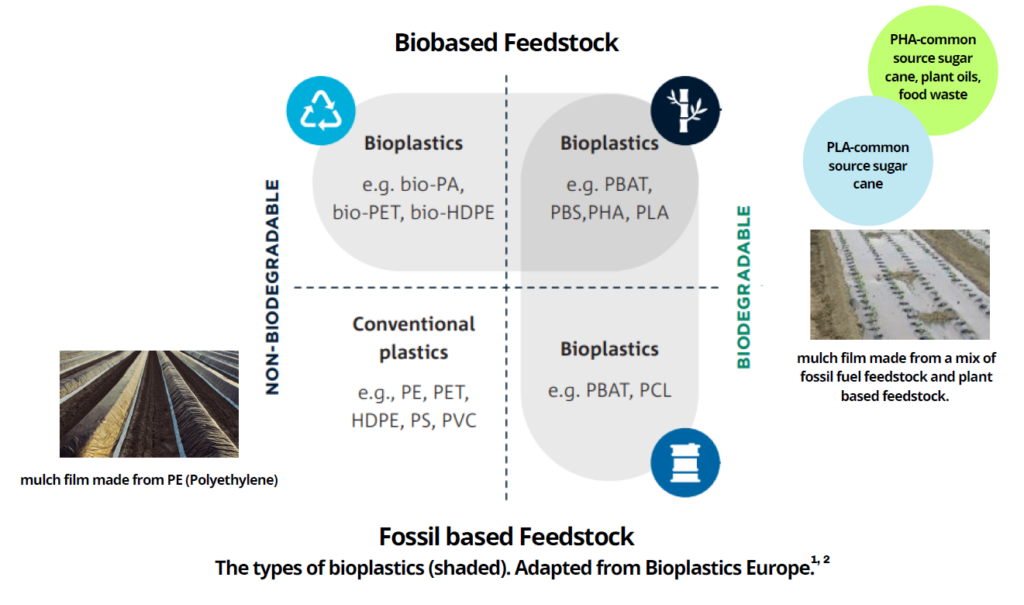
Plastics and bioplastics can be categorised based on their origin/feedstock (biobased vs. fossil fuel based) and their degradation properties (biodegradable vs. non-biodegradable).

Feedstocks

Fossil-based feedstocks: Derived from petroleum, natural gas, or coal.

Biobased feedstocks: Derived from plants, algae, or agricultural waste products.

Differences in degradation

Download the fact sheet to learn more about plastics and bioplastics.

Biodegradable materials are those that can be fully broken down into natural substances, such as water and carbon dioxide, by naturally occurring microorganisms. In waste management, the term “biodegradable” is broadly used to describe materials that degrade either under composting conditions or in the natural environment. The key distinction is that compostable materials are designed to break down within a specific timeframe under controlled composting conditions, where factors like temperature, moisture, and microbial activity are optimised to accelerate decomposition and biomass formation.

Certified compostable

Compostable refers to a product’s ability to biodegrade into non-toxic, natural elements within a defined timeframe under specific composting conditions. Both fossil-based and bio-based bioplastics can be certified as compostable. However, compostability claims should only be made if the product has been certified to a recognised standard, such as Australian Standards AS 4736-2006 or AS 5810-2010.

Biobased bioplastic biodegradable

Smart sprays belong to this category.

Bioplastics made from bio-based feedstocks that fully break down into natural substances, either under composting conditions or in the natural environment. PHA bioplastics, in particular, are known to degrade effectively in both soil and marine environments.

Fossil-based bioplastic biodegradable

Fossil-based biodegradable plastics make up a relatively small category, which includes materials like PBAT and PCL. While PBAT is both biodegradable and compostable, improper disposal can still have environmental consequences, as its degradation requires specific conditions to occur efficiently.

Biobased bioplastic non-biodegradable

Bioplastics can be derived from bio-based feedstocks while remaining non-biodegradable. These materials are chemically identical to traditional fossil-based plastics.

Conventional plastics non-biodegradable

These materials do not biodegrade. In Australia, 2.9 million tonnes of plastic waste are discarded each year, with only 13% recycled, while the remaining 87% ends up in landfill.

Reference: State of Bioplastics in Australia, CSIRO, 2024 with permission.

Download the fact sheet to learn more about plastics and bioplastics.

News

Resources

Additional resources

Collaborators

Project team

Theo Nabben

SW WA Hub

Mary-Anne Glanzlowe

SW WA Hub

Contact

Theo Nabben

Monitoring, Evaluation and Learning Manager, South-West WA Drought Resilience Adoption and Innovation Hub
theo.nabben@gga.org.au
0403 196 381

Start date:
24/11/2025
End date:
30/06/2027
Status:
Project lead:
SW WA Hub
Funder:
DAFF – Future Drought Fund
Hub role:
Project sponsor, Delivery, Project management, Extension and communications
Commodity:
Broadacre cropping, Dairy, Horticulture and viticulture, Livestock, Mixed farming
Resilience type:
Economic, Environmental
Relevant region:
Lower South West, Mid West & Gascoyne Coastal, Southern Rangelands, Wheatbelt